
.jpg)
.jpg)

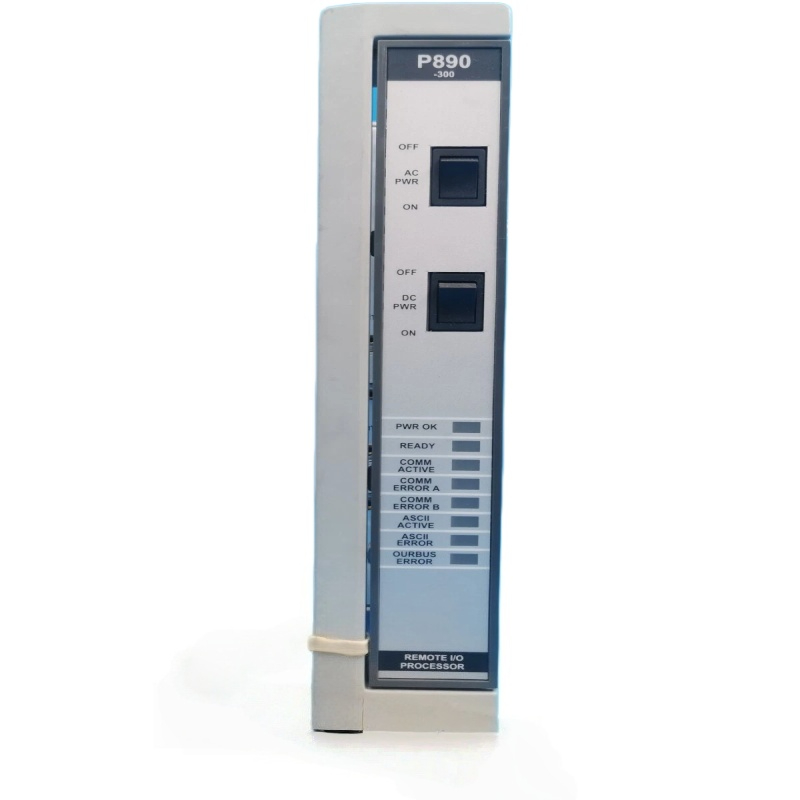
Schneider ASP890300 is a highly integrated Remote I/O Processor manufactured by Schneider Electric. It belongs to the Modicon series, model P890-300. It is typically used as a “RIO Receiver” and is primarily responsible for receiving and processing signal data from field I/O modules.
1. Core Functions and Role
The main role of the ASP890300 is to act as a “bridge” between field I/O modules (such as sensors and actuators) and the PLC (Programmable Logic Controller) or host control system.
Signal Processing:
Receives analog signals (such as 0–10V) and digital signals (such as switch signals) from remote I/O modules.
Data Transmission:
Transmits the collected signal data to the PLC via dedicated communication protocols (such as Modbus RTU or Schneider proprietary protocols).
Power Supply:
In addition to functioning as a receiver, it includes a built-in power supply module (power-supply version available), providing power to field I/O modules and eliminating the need for separate external power wiring.
2. Key Technical Specifications
According to official documentation and technical manuals, the ASP890300 has the following main specifications:
| Parameter | Description |
|---|---|
| Model | ASP890300 (also referred to as AS-P890-300 in some documents) |
| Input Channels | Supports multiple analog inputs (e.g., 8 channels) and digital inputs |
| Communication Interface | Uses dedicated Modicon RIO interface, typically connected via coaxial cable |
| Supply Voltage | 24V DC (power-supply version) |
| Operating Temperature | -20°C to +65°C (industrial grade) |
| Protection Rating | IP30 |
| Installation Method | DIN rail mounting, slot mounting |
| Compatibility | Compatible with 800 series rack systems (such as H810, H819, H827, etc.) |
3. Application Scenarios
The ASP890300 is widely used in various industrial automation systems, including:
Distributed Control Systems (DCS):
Suitable for large-scale factories with distributed I/O layouts, enabling centralized management of field equipment.
Remote Monitoring:
In situations where field equipment cannot be directly connected to the PLC, signals can be transmitted to the control room via coaxial cable.
Reduced Wiring Costs:
By using a single coaxial cable to transmit both power and signal, it significantly reduces wiring complexity and installation costs.